
The Hierarchy of Controls: A Practical Guide to Workplace Hazard Prevention

When a workplace hazard is identified, the next question is simple: What can be done to prevent someone from getting hurt?
There may be several ways to address the problem, but not all solutions provide the same level of protection. Requiring employees to wear protective equipment, for example, may reduce their exposure to a hazard. Eliminating the hazard entirely can often prevent that exposure from occurring in the first place.
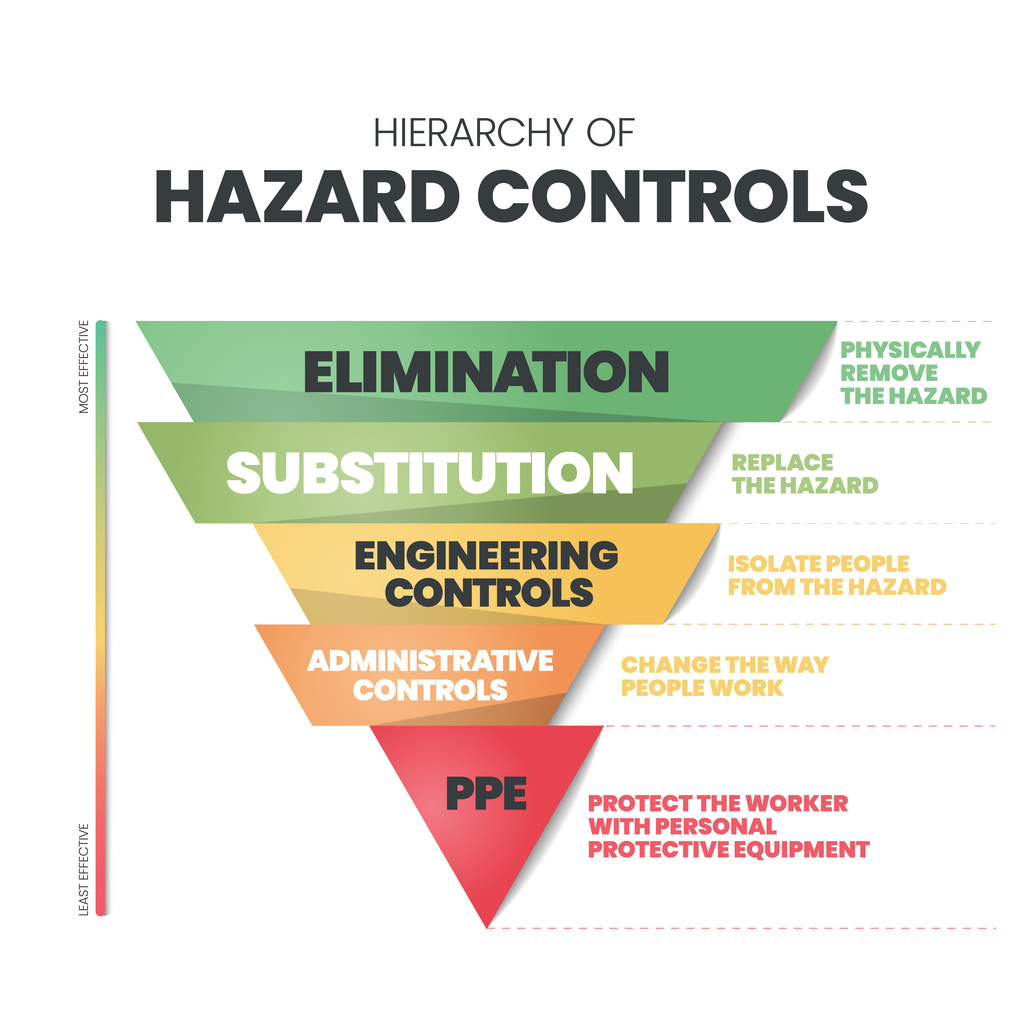
The Hierarchy of Controls is a framework used in workplace safety to help employers evaluate hazards and select the most effective ways to control them. It ranks five approaches, from the most effective to the least effective: elimination, substitution, engineering controls, administrative controls, and personal protective equipment (PPE).
Understanding how these controls work can help organizations move beyond simply reminding employees to be careful and focus on making work safer by design.
What Is the Hierarchy of Controls?
The Hierarchy of Controls is a system for prioritizing methods of hazard prevention. Developed and promoted by occupational safety organizations, including the National Institute for Occupational Safety and Health (NIOSH), it encourages employers to consider stronger hazard controls before relying on measures that depend heavily on employee behavior.
The five levels are:
- Elimination: Physically remove the hazard.
- Substitution: Replace the hazard with something less hazardous.
- Engineering controls: Isolate people from the hazard.
- Administrative controls: Change how people work to reduce exposure.
- Personal protective equipment (PPE): Protect workers with equipment worn or used while performing a task.
The hierarchy is generally presented as a pyramid, with elimination at the top and PPE at the bottom. The order reflects the relative effectiveness of these approaches in preventing exposure to hazards.
This doesn’t mean lower-level controls are unnecessary. In many workplaces, a combination of controls is needed. The goal is to prioritize the most effective options that are feasible for the hazard and task.
1. Elimination: Remove the Hazard Entirely
Elimination is the most effective level of the hierarchy because it removes the hazard from the workplace or removes the need for workers to encounter it.
If the hazard no longer exists, workers no longer need to rely on procedures, training, or protective equipment to avoid it.
Examples of elimination include:
- Removing the need to perform work at height by completing an assembly task at ground level.
- Eliminating a hazardous chemical from a process when the process can be redesigned without it.
- Removing damaged or defective equipment from service rather than allowing continued use.
- Redesigning a material-handling process so employees no longer need to manually lift heavy objects.
Elimination often requires planning and may involve changes to equipment, processes, facility layouts, or purchasing decisions. However, considering elimination early—especially when designing a new process or purchasing new equipment—can prevent hazards from becoming permanent parts of the job.
The most useful question to ask is: Can we change the way this work is done so the hazard is no longer present?
2. Substitution: Replace the Hazard With a Safer Alternative
Sometimes a hazard cannot be eliminated completely, but it may be possible to replace it with something less dangerous.
Substitution reduces risk by changing the material, product, equipment, or process responsible for creating the hazard.
Examples of substitution include:
- Replacing a solvent-based cleaning product with a less hazardous alternative.
- Using a less toxic chemical in place of a more hazardous one.
- Choosing a lower-noise tool or piece of equipment.
- Replacing a highly hazardous material with a less hazardous material that performs the same function.
Substitution requires careful evaluation. An alternative that reduces one hazard may introduce another. For example, a replacement chemical may be less toxic but more flammable, or a different cleaning process may create additional ergonomic concerns.
Before making a change, employers should evaluate the alternative’s hazards, review relevant safety data, and determine whether the substitution actually reduces overall risk.
The question to ask is: Can we accomplish the same task using a less hazardous material, product, or process?
3. Engineering Controls: Isolate Workers From the Hazard
Engineering controls protect workers by physically separating them from a hazard or preventing the hazard from reaching them.
Unlike administrative controls and PPE, engineering controls generally do not depend on employees consistently remembering to follow a procedure or wear protective equipment to provide protection.
Examples of engineering controls include:
- Installing machine guards to prevent contact with moving parts.
- Using local exhaust ventilation to capture airborne contaminants near their source.
- Installing barriers or enclosures around hazardous processes.
- Using mechanical lifting devices to reduce manual handling risks.
- Installing noise enclosures around loud machinery.
- Adding physical barriers to separate pedestrians from powered industrial trucks.
Engineering controls are particularly valuable because they can protect multiple employees and may provide consistent protection during routine operations.
However, they must be properly designed, installed, maintained, and used. A machine guard that is removed or a ventilation system that no longer functions properly cannot provide the intended level of protection.
The question to ask is: Can we physically separate workers from the hazard or prevent exposure through equipment or workplace design?
4. Administrative Controls: Change How the Work Is Performed
Administrative controls reduce risk by changing work practices, procedures, schedules, or employee activities. They help establish expectations for how work should be performed and how exposure to hazards can be reduced.
These controls are often necessary, but their effectiveness depends on how well procedures are developed, communicated, implemented, and followed.
Examples of administrative controls include:
- Establishing safe operating procedures for equipment.
- Training employees to recognize hazards and perform tasks safely.
- Limiting the amount of time employees are exposed to excessive noise or other hazards.
- Rotating employees between tasks when appropriate to reduce individual exposure.
- Establishing restricted areas and access procedures.
- Conducting regular workplace inspections.
- Implementing preventive maintenance schedules.
- Establishing procedures for reporting hazards, near misses, and unsafe conditions.
Administrative controls are important components of a safety program. Training, communication, inspections, and clear procedures help employees understand hazards and know what actions to take.
However, these measures do not physically remove the hazard. Employees may forget a procedure, misunderstand instructions, or face production pressures that encourage shortcuts. For this reason, administrative controls should be used alongside stronger controls whenever practical.
The question to ask is: Can we change the way the work is organized or performed to reduce the likelihood or duration of exposure?
5. Personal Protective Equipment (PPE): Protect Workers From Remaining Hazards
Personal protective equipment is worn or used by employees to reduce exposure to workplace hazards. Depending on the task, PPE may include safety glasses, face shields, gloves, hearing protection, respirators, protective footwear, hard hats, or fall protection equipment.
PPE plays an essential role in many workplace safety programs. Some hazards cannot be completely eliminated, and PPE may be necessary even when other controls are in place.
Examples of PPE include:
- Safety glasses or face shields to protect against flying particles and chemical splashes.
- Hearing protection to reduce exposure to hazardous noise.
- Gloves selected for the specific chemical, material, or task involved.
- Respirators when required to protect against inhalation hazards.
- Hard hats to protect against applicable impact and falling-object hazards.
- Fall protection equipment when required for work at height.
PPE is placed at the bottom of the hierarchy because it generally does not eliminate the hazard itself. Its effectiveness depends on selecting the right equipment, ensuring proper fit, maintaining it, and using it correctly and consistently.
For example, requiring employees to wear hearing protection may reduce their exposure to hazardous noise. Enclosing a noisy machine or replacing it with quieter equipment may reduce the noise exposure at its source and provide protection that does not depend entirely on individual behavior.
Employers should not interpret PPE’s position in the hierarchy to mean it is optional or unimportant. Applicable OSHA standards may specifically require certain PPE, and workers must receive appropriate equipment and training when required.
The question to ask is: What protective equipment is needed to address the hazards that remain after other controls have been considered and implemented?
Putting the Hierarchy of Controls Into Practice
Knowing the five levels is only the first step. The real value comes from applying them when hazards are identified.
Consider a manufacturing employee who is exposed to excessive noise from a production machine.
A response focused only on PPE might involve providing hearing protection and reminding employees to wear it. That may be necessary, but the Hierarchy of Controls encourages the employer to evaluate additional options.
- Elimination: Can the noisy operation be removed or redesigned so the noise is no longer generated?
- Substitution: Can the machine or process be replaced with a quieter alternative?
- Engineering controls: Can the machine be enclosed or isolated to reduce noise exposure?
- Administrative controls: Can access or exposure time be managed appropriately while other controls are evaluated or implemented?
- PPE: What hearing protection is needed for any remaining exposure?
The best solution may involve several of these measures rather than one control alone.
This example illustrates an important principle: selecting PPE or providing training should not automatically end the evaluation. Employers should consider whether stronger measures can reduce the hazard at its source.
How the Hierarchy of Controls Fits Into a Safety Program
The Hierarchy of Controls works best when it is part of an ongoing process for identifying hazards, evaluating risks, and implementing corrective actions.
Workplace inspections, employee observations, incident investigations, near-miss reports, and job hazard analyses can all reveal situations where controls may be missing, inadequate, or no longer effective.
When a hazard is identified, employers can use the hierarchy to guide the next steps:
- Identify the hazard. Determine what could cause injury or illness and who could be exposed.
- Evaluate the risk. Consider the potential severity of harm, the likelihood of exposure, and the conditions under which the work is performed.
- Evaluate control options. Start with elimination and work down the hierarchy, considering applicable requirements and the feasibility of each option.
- Implement the selected controls. Assign responsibility, establish a timeline, and provide the resources needed to address the hazard.
- Verify effectiveness. Confirm that the control was implemented properly and is reducing the risk as intended.
- Reevaluate when conditions change. New equipment, materials, processes, or work practices may introduce hazards or make existing controls less effective.
Employee involvement is especially valuable throughout this process. Employees performing the work often have practical insight into how a task is completed, where problems occur, and whether a proposed solution will work in actual conditions.
Documentation also helps organizations track identified hazards, the controls selected, corrective actions, and follow-up evaluations. This creates a record of how safety concerns are being addressed and can help reveal recurring problems across departments or locations.
The Bottom Line
The Hierarchy of Controls provides a straightforward way to think about hazard prevention: Don’t start by asking how employees can protect themselves from a hazard. Start by asking whether the hazard can be eliminated or controlled at its source.
Training, procedures, and PPE remain important parts of workplace safety. But when employers rely on them as the primary solution to every problem, they may miss opportunities to make work inherently safer.
A stronger approach considers the full range of controls, prioritizes the most effective feasible options, and verifies that the selected measures are working.
When the hierarchy becomes part of everyday hazard assessments, inspections, and corrective-action decisions, it helps organizations move from reacting to unsafe conditions toward preventing injuries and illnesses before they occur.
For additional guidance, see NIOSH’s Hierarchy of Controls and OSHA’s Recommended Practices for Safety and Health Programs.