
Preventing Workplace Musculoskeletal Disorders: Applying the Hierarchy of Controls to Reduce Ergonomic Risks


Musculoskeletal disorders (MSDs) are among the most common workplace injuries across nearly every industry. Whether employees work in manufacturing, construction, healthcare, warehousing, agriculture, or an office environment, the risk of strains, sprains, and repetitive motion injuries is often present.
Unlike many workplace injuries that occur in a single moment, musculoskeletal disorders frequently develop over time. Repeated lifting, awkward postures, forceful exertions, repetitive motions, and even prolonged sitting or standing can gradually place stress on the body until pain or injury develops.
The encouraging news is that many MSDs are preventable. One of the most effective ways to reduce ergonomic risks is by applying the Hierarchy of Controls, which is a framework used throughout occupational safety to identify the most effective methods for controlling workplace hazards.
What Are Musculoskeletal Disorders?
Musculoskeletal disorders are injuries or disorders that affect the muscles, tendons, ligaments, joints, nerves, cartilage, or spinal discs.
Common examples include:
- Low back strains
- Tendonitis
- Carpal tunnel syndrome
- Rotator cuff injuries
- Shoulder strains
- Tennis elbow
- Trigger finger
- Knee injuries
- Neck pain
These injuries often develop gradually rather than from a single traumatic event. Employees may initially experience soreness, stiffness, numbness, or fatigue before symptoms become severe enough to require medical treatment or time away from work.
Common Ergonomic Risk Factors
Every workplace is different, but several ergonomic risk factors appear repeatedly across industries.
These include:
- Repetitive motions
- Heavy or frequent lifting
- Forceful pushing or pulling
- Awkward body positions
- Overreaching
- Twisting while lifting
- Prolonged kneeling or squatting
- Working overhead
- Contact stress from tools or equipment
- Whole-body or hand-arm vibration
- Long periods of standing or sitting
The greater the frequency, force, and duration of these activities, the greater the potential for injury.
Why Musculoskeletal Disorders Matter
Beyond the pain experienced by employees, MSDs can have a significant impact on an organization.
They often result in:
- Lost workdays
- Restricted duty assignments
- Increased workers’ compensation costs
- Reduced productivity
- Overtime expenses
- Employee turnover
- Lower morale
Because these injuries often develop gradually, organizations may overlook early warning signs until multiple employees begin reporting similar symptoms.
Paying attention to discomfort before it becomes an injury can provide valuable opportunities for prevention.
Applying the Hierarchy of Controls
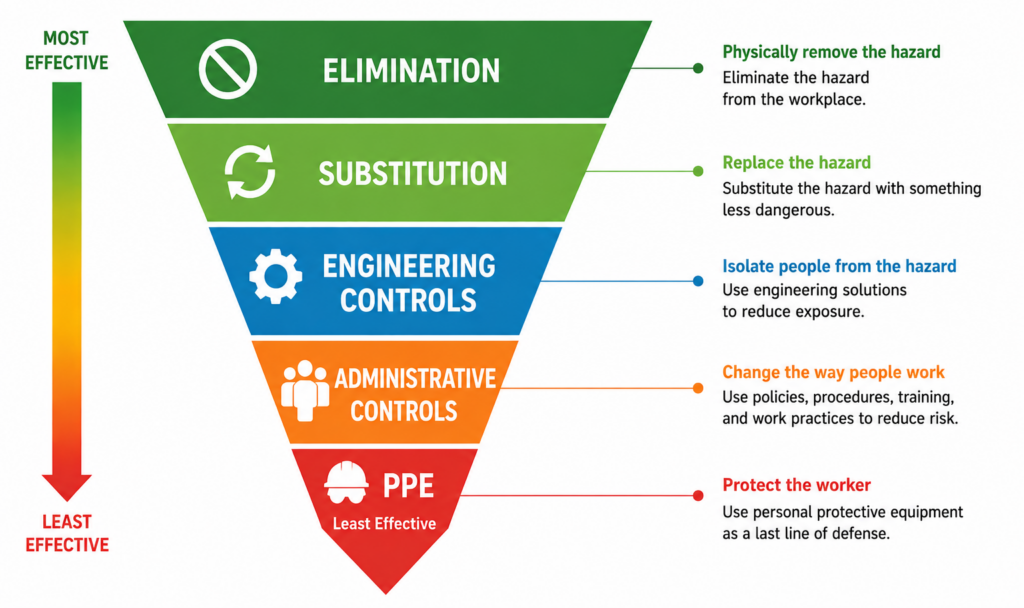
When addressing ergonomic hazards, it’s tempting to begin by reminding employees to “lift properly” or “be careful.”
While employee training is important, OSHA’s Hierarchy of Controls reminds us that the most effective solutions are those that remove or reduce the hazard itself and not simply rely on workers to avoid it.
1. Elimination
The most effective control is eliminating the hazard altogether.
Questions to consider include:
- Can manual lifting be eliminated?
- Can materials be delivered closer to where they’re needed?
- Can tasks be automated?
- Can unnecessary handling be removed from the process?
If employees don’t have to perform a hazardous task, the associated ergonomic risk disappears.
2. Substitution
If the hazard can’t be eliminated, consider replacing the task or equipment with something that creates less physical strain.
Examples include:
- Using lighter materials
- Selecting tools that require less force
- Choosing equipment designed with ergonomics in mind
- Replacing high-vibration tools with lower-vibration alternatives
Even modest improvements can reduce cumulative stress over time.
3. Engineering Controls
Engineering controls are often among the most effective ergonomic improvements because they physically reduce the demands placed on employees.
Examples include:
- Adjustable workstations
- Lift tables
- Hoists
- Vacuum lifting devices
- Conveyor systems
- Height-adjustable carts
- Ergonomically designed tools
- Mechanical material handling equipment
Rather than asking employees to work around a difficult task, engineering controls redesign the work itself.
4. Administrative Controls
When hazards can’t be fully engineered out of the process, administrative controls can help reduce exposure.
These may include:
- Rotating job assignments
- Scheduling regular recovery breaks
- Limiting repetitive tasks
- Reducing overtime on physically demanding jobs
- Adjusting staffing levels
- Performing ergonomic assessments
- Encouraging early reporting of discomfort
- Providing ergonomic awareness training
Administrative controls don’t remove the hazard, but they can significantly reduce the amount of exposure employees experience throughout the day.
5. Personal Protective Equipment (PPE)
PPE represents the final level of the Hierarchy of Controls.
Unlike other workplace hazards, PPE generally plays a limited role in preventing musculoskeletal disorders.
For example, gloves may improve grip or reduce contact stress, but they won’t eliminate awkward lifting or repetitive motion.
Likewise, back belts are sometimes viewed as a solution for lifting injuries. However, they should not be considered a substitute for ergonomic improvements or safe work practices. The focus should remain on reducing the physical demands of the job itself whenever possible.
Building an Ergonomics Program
Reducing musculoskeletal disorders isn’t accomplished through one solution alone.
Successful organizations typically combine several strategies, including:
- Performing ergonomic assessments
- Evaluating high-risk tasks
- Involving employees in identifying problems
- Reviewing injury trends
- Investigating near misses
- Improving workstation design
- Providing practical training
- Periodically reassessing work processes
Employees often know where the greatest physical challenges exist because they perform the work every day. Their input can be invaluable when identifying opportunities for improvement.
Prevention Starts with Workplace Design
One of the biggest shifts in modern ergonomics is recognizing that workplace injuries shouldn’t be viewed solely as employee problems. They’re often workplace design problems.
When jobs require excessive reaching, repetitive lifting, awkward postures, or unnecessary force, employees are naturally placed at greater risk.
Applying the Hierarchy of Controls encourages organizations to ask a different question.
Instead of asking, “How can we teach employees to work around this hazard?”
Ask, “How can we redesign the work so the hazard is reduced in the first place?”
That mindset not only helps reduce musculoskeletal disorders but also improves productivity, quality, and employee satisfaction.
By identifying ergonomic risks early and applying the Hierarchy of Controls, organizations can create workplaces that are safer, more efficient, and better equipped to protect employees from one of the most common categories of workplace injuries.