
OSHA Recordkeeping Requirements Explained

OSHA recordkeeping is one of the most misunderstood aspects of workplace safety. Many employers know they’re required to document workplace injuries and illnesses, but they’re often unsure which businesses are covered, what records must be maintained, and how to determine what should be recorded.
Proper OSHA recordkeeping is about much more than regulatory compliance. Accurate records help employers identify injury trends, evaluate the effectiveness of their safety programs, and make informed decisions that reduce future incidents.
Whether you’re new to OSHA recordkeeping or simply want to ensure your organization is meeting its obligations, understanding the basics is an important part of maintaining a successful safety program.
What Is OSHA Recordkeeping?
OSHA recordkeeping refers to the process of documenting certain work-related injuries and illnesses using standardized OSHA forms. These records help OSHA monitor workplace injury trends across industries while giving employers valuable data to evaluate their own safety performance.
It’s important to understand that recordkeeping and reporting are not the same thing.
- Recordkeeping involves documenting recordable workplace injuries and illnesses using OSHA’s required forms.
- Reporting refers to notifying OSHA about certain severe incidents, such as fatalities, in-patient hospitalizations, amputations, or the loss of an eye, within specific timeframes.
It’s common to confuse these two requirements, but both play an important role in OSHA compliance.
Which Employers Must Keep OSHA Records?
Not every employer is required to maintain OSHA injury and illness records. In general, OSHA recordkeeping requirements apply to employers with more than 10 employees, unless their business falls within an industry that OSHA has designated as partially exempt due to historically low injury and illness rates.
Even if your business is exempt from maintaining OSHA injury logs, you are still responsible for:
- Providing a safe workplace
- Complying with applicable OSHA standards
- Reporting severe workplace injuries when required
Understanding whether your organization must maintain OSHA records is an important first step toward compliance.
The Three Primary OSHA Recordkeeping Forms
Most employers subject to OSHA recordkeeping requirements will become familiar with three primary forms.
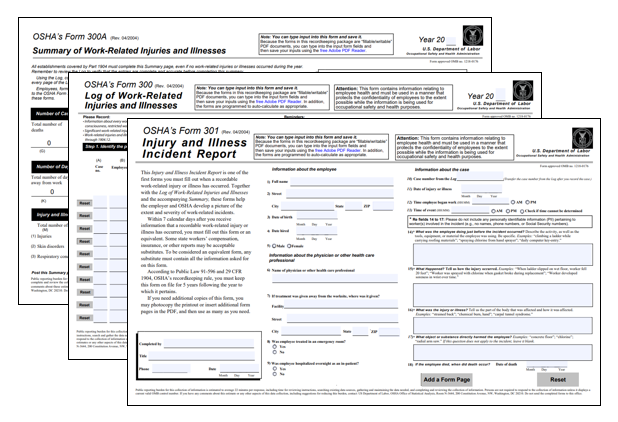
OSHA Form 300 – Log of Work-Related Injuries and Illnesses
This form serves as the ongoing log of recordable workplace injuries and illnesses throughout the year. Each recordable incident is entered into the log with information including:
- Employee information
- Date of injury or illness
- Description of the incident
- Classification of the case
- Days away from work or restricted duty
The OSHA 300 Log provides an overview of an organization’s workplace injury history.
OSHA Form 301 – Injury and Illness Incident Report
While the OSHA 300 Log summarizes each incident, the OSHA 301 form documents the details of an individual case. This report typically includes:
- How the incident occurred
- What the employee was doing
- The injury or illness sustained
- Medical treatment information
- Contributing factors
Think of Form 301 as the detailed report supporting each entry on the OSHA 300 Log.
OSHA Form 300A – Summary of Work-Related Injuries and Illnesses
At the end of each calendar year, employers prepare OSHA Form 300A. Rather than listing individual incidents, this form summarizes the organization’s injury and illness totals for the year.
For covered employers, the OSHA 300A Summary must be certified by a company executive and posted in a visible workplace location during OSHA’s required posting period so employees can review the organization’s injury statistics.
What Injuries and Illnesses Must Be Recorded?
Not every workplace injury or illness belongs on the OSHA 300 Log. Generally, an injury or illness is recordable if it is:
- Work-related
- A new case
- Meets one or more OSHA recording criteria
Common recording criteria include:
- Death
- Days away from work
- Restricted work or job transfer
- Medical treatment beyond first aid
- Loss of consciousness
- A significant diagnosed injury or illness
Determining whether an incident is OSHA recordable isn’t always straightforward. Employers should carefully evaluate each case and consult OSHA guidance whenever questions arise.
Why Accurate Recordkeeping Matters
Some employers view OSHA recordkeeping as paperwork required only to satisfy government regulations. In reality, accurate records provide valuable insight into workplace safety performance. By reviewing injury and illness trends, organizations can identify:
- Recurring hazards
- High-risk job tasks
- Frequently injured departments
- Equipment issues
- Opportunities for additional employee training
This information allows employers to take proactive steps before small issues become serious incidents.
Accurate recordkeeping also demonstrates that an organization takes workplace safety seriously and maintains organized documentation should an OSHA inspection occur.
Common OSHA Recordkeeping Mistakes
It’s not unusual to make recordkeeping mistakes. Some of the most common include:
- Failing to determine whether an injury/illness is recordable
- Recording non-recordable injuries/illnesses
- Missing required documentation
- Recording incidents incorrectly
- Waiting too long to complete OSHA forms
- Forgetting to post the OSHA 300A Summary
- Maintaining incomplete employee incident records
These errors can create unnecessary compliance issues and make it more difficult to identify meaningful safety trends.
Digital Recordkeeping Simplifies Compliance
Many organizations still maintain OSHA records using paper files or disconnected systems. While these methods may work at first, they often become difficult to manage over time or as organizations grow.
Digital safety management software centralizes incident reporting, investigation records, employee information, corrective actions, and OSHA documentation into a single platform.
Instead of searching through multiple files during an audit or inspection, safety professionals and managers can quickly access the information they need while maintaining accurate, organized records throughout the year.
How WorkerSafe Supports OSHA Recordkeeping
WorkerSafe helps organizations simplify OSHA recordkeeping by integrating incident reporting and OSHA recordkeeping into one system.
Incident tracking enables an employer to document work-related injuries and illnesses in a centralized location, while OSHA recordkeeping functionality works with the incident tracker, enabling employers to record and manage work-related injuries and illnesses in accordance with OSHA recordkeeping requirements.
By connecting recordkeeping with the rest of a company’s safety program, WorkerSafe helps reduce administrative work while improving compliance and visibility into workplace safety performance.
Good Recordkeeping Supports Better Safety
OSHA recordkeeping isn’t simply about filling out forms; it’s about understanding what workplace injuries are telling you.
Accurate records help employers recognize trends, identify opportunities for improvement, strengthen compliance efforts, and ultimately create safer workplaces for their employees.
Organizations that maintain organized, consistent records are not only better prepared for OSHA inspections, they’re also better equipped to prevent future incidents and build a stronger, more proactive safety culture.
When recordkeeping becomes part of an integrated safety management system rather than a once-a-year administrative task, it transforms from a compliance requirement into a valuable tool for continuous improvement.
Click here to learn more about OSHA’s recordkeeping requirements.