
OSHA Recordkeeping: Understanding the Three Key Requirements

Workplace injuries and illnesses don’t just create challenges for employees and employers. They also create recordkeeping responsibilities that organizations need to understand and manage.
OSHA’s injury and illness recordkeeping requirements are designed to help employers, employees, and OSHA identify workplace hazards, recognize trends, and prevent future incidents.
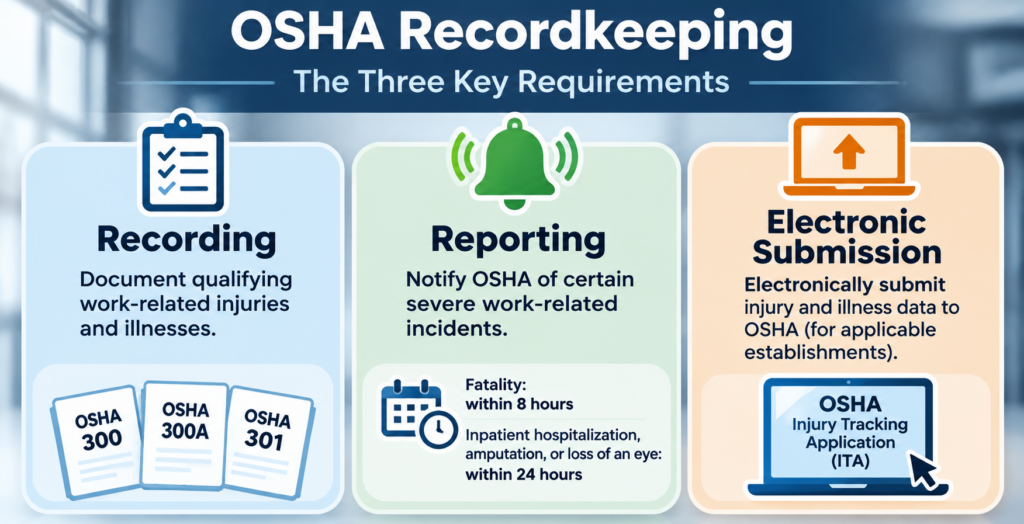
Under 29 CFR Part 1904, OSHA divides its recordkeeping requirements into three main components: recording, reporting, and electronic submission. While they are related, each serves a different purpose.
1. Recording: Documenting Work-Related Injuries and Illnesses
Recording involves documenting qualifying work-related injuries and illnesses using OSHA’s required recordkeeping forms.
Many employers with more than 10 employees must maintain records of work-related injuries and illnesses that meet OSHA’s recordability criteria. Certain low-hazard industries are exempt from routine recordkeeping requirements.
The three primary OSHA recordkeeping forms are:
- OSHA Form 300 – Log of Work-Related Injuries and Illnesses: Records individual work-related injuries and illnesses that meet OSHA’s recording criteria.
- OSHA Form 300A – Summary of Work-Related Injuries and Illnesses: Provides an annual summary of the establishment’s recorded injuries and illnesses. It must be certified by a company executive and posted from February 1 through April 30 each year.
- OSHA Form 301 – Injury and Illness Incident Report: Captures additional details about each recordable injury or illness.
Not every workplace injury needs to be recorded. OSHA has specific criteria for determining whether an incident is recordable, including cases involving death, days away from work, restricted work or job transfer, medical treatment beyond first aid, loss of consciousness, or certain significant diagnosed injuries and illnesses.
Employers need to understand these criteria to ensure incidents are classified and documented correctly.
2. Reporting: Notifying OSHA of Severe Incidents
Recording an injury on an OSHA log is different from reporting a severe incident directly to OSHA.
All employers under OSHA jurisdiction must report certain severe work-related incidents to OSHA within specific timeframes:
- Workplace fatality: Must be reported within 8 hours.
- Work-related inpatient hospitalization, amputation, or loss of an eye: Must be reported within 24 hours.
These reporting requirements apply even to employers who are otherwise exempt from routine OSHA recordkeeping due to company size or industry.
It’s important to understand that an inpatient hospitalization generally means formal admission to a hospital for care or treatment. An emergency room visit alone does not make an injury or illness reportable to OSHA.
Employers should have a process for promptly communicating serious incidents to the appropriate personnel so required notifications aren’t missed.
3. Electronic Submission: Sending Injury and Illness Data to OSHA
In addition to maintaining injury and illness records, certain employers must electronically submit information to OSHA each year.
OSHA collects this information through its Injury Tracking Application (ITA). The electronic submission requirement applies to establishments that meet specific employee-size and industry criteria.
Depending on the establishment’s requirements, employers may need to electronically submit information from OSHA Forms 300, 300A, and 301.
Annual submissions are generally due between January 2 and March 2 for the previous calendar year’s data.
Employers should review OSHA’s current requirements to determine whether their establishments are required to submit information and which forms or data fields apply.
Simplifying OSHA Recordkeeping With WorkerSafe
Keeping up with OSHA recordkeeping requirements can be challenging, particularly for organizations managing incidents across multiple locations. WorkerSafe’s Incident Management feature helps simplify the process by bringing injury and illness documentation and OSHA recordkeeping together in one place.
WorkerSafe uses a guided incident reporting process to capture the information needed for OSHA recordkeeping. As incidents are entered and updated, the platform automatically generates the three primary OSHA forms:
- OSHA Form 300: Log of Work-Related Injuries and Illnesses
- OSHA Form 300A: Annual Summary of Work-Related Injuries and Illnesses
- OSHA Form 301: Injury and Illness Incident Report
For organizations looking to spend less time managing paperwork and more time improving workplace safety, WorkerSafe provides a centralized way to manage incident documentation and OSHA recordkeeping.
Understanding Your OSHA Recordkeeping Responsibilities
Recording, reporting, and electronic submission are three separate responsibilities, but they work together as part of an effective injury and illness recordkeeping process.
Employers need to know which incidents must be recorded, understand when OSHA must be notified of a severe incident, and determine whether annual electronic submission is required.
Accurate and timely recordkeeping isn’t just about meeting regulatory requirements. It also helps organizations identify recurring problems, recognize workplace hazards, and make informed decisions about where safety improvements are needed.
For additional information, forms, and guidance, visit OSHA’s Recordkeeping Requirements page, which provides resources to help employers understand and meet their responsibilities under 29 CFR Part 1904.